By April Yamasaki
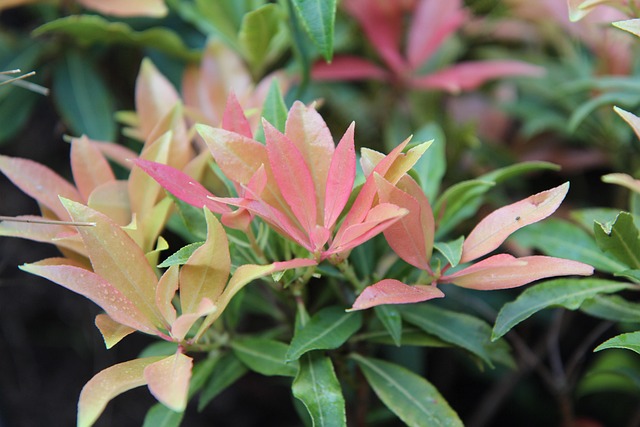
“Those are a couple of fire-on-the-mountain bushes,” the gardener said to me. She looked after the common areas of our townhouse complex — mowing the grass, pruning the bushes, and generally keeping the grounds looking healthy and well kept. But the garden area next to each townhouse was treated as personal property. Each household was to take care of their own garden. As a new resident, I decided to start by first asking the gardener to identify the different plants for me, and she was happy to oblige.
Of course, I recognized the large rhododendron bush by the front door, and the roses at the side of the house. But the fire-on-the-mountain bushes — more formally called pieris japonica — were new to me. How aptly named, I thought, for most of their leaves were dark green, but the new growth was a brilliant red, topping the plant like fire on a mountain.
Over the years, I watched over those two bushes as they continued to flourish. I welcomed their white flowers every spring and delighted in their new red leaves that turned green as they matured. But two years ago, after a hard winter, one of the bushes had clearly suffered. That winter had been so cold that the wind seemed to blow right through the house, and there was ice on the inside of the living room windows. The following spring, instead of fire on the mountain, the top third of the bush looked like mainly dead branches.
“I’ll come by and pull out that bush for you,” said one of my neighbours. The previous year, he had used a sturdy length of rope and his pick-up truck to pull out a large plant of heather that had died. But I wasn’t ready for him to do that to my ailing fire-on-the-mountain just yet.
“Thank you,” I said, “but first I’m going to trim away the dead branches, and see if the bush might come back. Maybe I can save it.”
So I pruned away the dead wood, and carefully rearranged the still living branches so their leaves would fill in some of the bare spots.
“That does look better,” said my neighbor, but I could tell he wasn’t yet convinced that the bush still deserved its place in my garden. Yet I continued to tend my bush all summer, and last winter wasn’t nearly as cold as the winter before. This spring, my bush once again lived up to its name as fire-on-the-mountain. Its evergreen leaves were once again crowned with new red growth. With patience, some gentle work, and judicious pruning, I had saved it.
As I reflect on Jesus as Savior, I’m grateful for his birth, life, death, resurrection, and ascension. I’m grateful for God’s patience, gentle work, and judicious pruning in my life. I am saved — out of hard winter to a new season, out of the molasses of grief to moving forward, from what looks like death to renewed life. I am saved by the power of God, the work of Christ, and the new life of the Spirit. Thanks be to God!
For it is by grace you have been saved, through faith—and this is not from yourselves, it is the gift of God. —Ephesians 2:8
April Yamasaki is a pastor, editor, author, and spiritual formation mentor. Her newest book is Hope Beyond Our Sorrows: Learning to Live with Life-Changing Loss, to be released later this month by Herald Press. In it, she shares some of her journey with grief after the unexpected death of her husband, and invites readers to join her in learning to live with faith and hope beyond their broken dreams. Whatever loss you’re living with, you will find comfort in her book’s short, easily digestible readings accompanied by prayers and spiritual practices. Learn more at AprilYamasaki.com



 aawolsisters.com
Leave a comment