I work for a nonprofit organization called Project Peace East Bay, and we recently shifted to a horizontal organizational structure. Rather than having a staff of divvied up roles answering to one executive director, we got rid of that position entirely and make decisions as a four-person team.
What makes a good leader? It’s not just about knowledge or authority. It is about empathy, being able to walk in and understand the experiences and struggles of others. Given the current state of the world, and all the hate we are witnessing throughout the country, empathy is all the more necessary for spiritual leaders to truly connect with their communities and congregations.
When Jesus called Simon to be his disciple, he told Simon he would be called Peter — Peter the leader of the early church. Jesus did not interview Simon for his IQ, EQ, talents, qualifications, and experiences. Simon did not write a thesis or pass an examining board to get his credentials to become Peter, the leader. If one were to check Simon Peter’s performance along the way, he had failed miserably — right after he aced the question of who Jesus was, he flunked by rebuking Jesus’ mission to the cross; he failed to grasp the meaning behind Jesus washing the disciples’ feet; he used his self-will to defend Jesus with a sword but denied him with his mouth. Despite all these “failures,” Jesus chose Simon and formed him to become Peter.
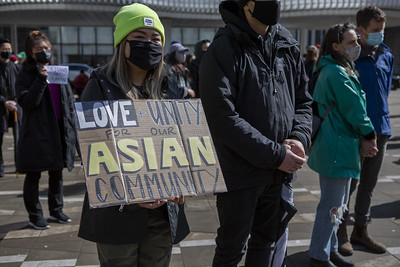
This month, our writers were asked to reflect on the relevancy of worship. For the first half of the month, our reflections revolved around the challenges of personal and corporate worship in the midst of the pandemic, with churches shut down and community limited. However, upon the mass shootings on three spas and massage parlors in Atlanta on March 16th that killed eight people, six of whom were Asian women, our reflections took a different turn, in grappling with how to worship amidst the collective trauma of the Asian and Asian American community — and in particular, we as Asian American women.
“It’s more of the same and yet different” were the words that echoed in a text message I received from a friend reaching out to show support and care this past week. More of the same racism, violence, and byproduct of white supremacy. And yet different in the racial identity of those targeted this time. The news was fresh: a white man targeted massage parlors in the Atlanta area and killed eight people, six of which were Asian women. Another shooting, another incidence of violence that reveals the deeply seeded impact and influence of white supremacy as it entrenches the dimensions and intersections of race, occupation, sexuality, religion, gender, age, and socioeconomics in the U.S.
As many of us know, the pandemic has shifted our understanding of what is “normal” and has without a doubt impacted all areas of our life. Last month, many of my Asian American sisters reflected upon what it means to have faith during these times of uncertainty. Now we shift to what it means to worship. While I reflect upon this theme of worship relevancy, what stands out to me the most is that while faith is something intangible that we all possess, worship is a verb that indicates action. Another way I look at it is, How do I take something intangible such as my faith, and put it into action through worshipping God in spirit and truth?
The church may have been caught off guard when the pandemic came to the US. Almost a year later, people still need best practices for corporate worship. The question should always be: How is our worship relevant to God, and then for God’s people? One West Coast church learned a hard lesson on how the virus spreads in close quarters from person to person from their nose or mouth. This caused fear of being with others when it involved singing or talking in person.
When I first started my website, AprilYamasaki.com, I used the tagline “Spiritual Practice, Faith, and Life.” I really didn’t know what to call my new blogging venture, but I figured I had to start with something, and I could always change my title later.
When it comes to my faith, it’s certainly not the first time I’ve felt lost. Like in college, when I was convinced that God had shown me my future husband, complete with divine signs and confirmations, only to find him engaged to someone else the following year. Or when I had left my evangelical Asian American church to join the PCUSA where women were encouraged to pursue ordination, only to find it supremely difficult to fit into any existing local PCUSA congregation. I remember telling my spiritual director that I felt like a football that was thrown, but then fumbled.
The views, actions, and affiliations of guests invited to write for this blog do not always reflect ISAAC’S official stances; they belong to the guests. This blog is a platform for voices to be shared and perspectives to be discussed.










 aawolsisters.com